

by Mary Gannon on 21 Apr, 2023
The earth supports each of us everyday, with water, sun, oxygen, and many other essential resources. On April 22nd, people around the world celebrate nature and the environment with Earth Day. Earth Day is an excellent opportunity to inform students on the importance of sustainability while bringing environmental awareness into the classroom.
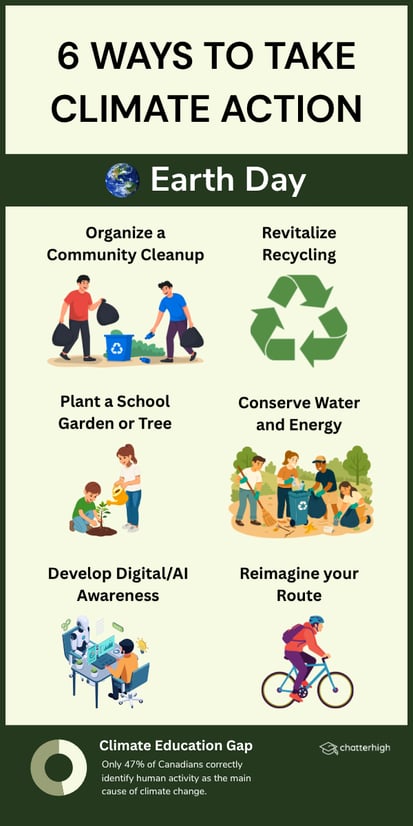
Environmental awareness not only engages students on Earth Day, but it can foster a better understanding of the climate, promoting climate action and positive climate solutions. Moreover, there is a gap in climate education even amongst adults, where only 47% of Canadians correctly identify human activity as the main cause of climate change. As climate change and its effects only grow in importance, Canadians of all ages can benefit from learning more about the climate crisis.
TL; DR
- Community Clean-up fosters collaboration and encourages active participation
- Revitalizing Recycling implements a recycling program while informing students on the benefits of Reduce, Reuse, and Recycle
- Plant a school garden to help your students and community connect with nature
- Conserve water and energy to do your part in preserving natural resources
- Develop your Digital Skills to effectively and ethically use AI while building a digital citizen toolkit
- Reimagine your route to explore how transportation affects climate change
Community Cleanup
The environment plays a pivotal role in our everyday lives, and as such, we should each help contribute to its well-being. As an educator, you could organize a community cleanup to help engage and educate students while actively contributing to your school and community.
According to a study at Harvard University, students learn better in an active-learning environment, which community cleanup provides. As students work collaboratively to understand both the task and its importance, they apply various skills that help solidify their learning. What’s more, this activity allows students to see the direct impact of their efforts, which further encourages students to take action beyond the classroom.
Revitalize Recycling
 Everyone has heard the saying “Reduce, Reuse, Recycle,” but how many people actually put it into practice? Recycling is still one of the most effective ways individuals can take action against climate change, which is why students should start practicing recycling today.
Though recycling does not provide the biggest benefit to the earth compared to other climate initiatives, it remains one of the few ways students can get involved. The facility with which students can participate in recycling initiatives gives them a sense of agency over the climate crisis, which in turn creates motivation for how they can positively contribute. Reminding students of the importance of “Reduce, Reuse, and Recycle” will foster healthy habits while educating students on pollution and overconsumption and how they each contribute to climate change.
Climate change is an immense and often overwhelming topic, and therefore finding reliable and reputable educational resources may prove difficult. ChatterHigh’s New Brunswick Climate Action Ed Competition dives into all things climate-related, from pollution and recycling to natural disasters and greenhouse emissions. If you want to provide students with comprehensive and engaging material, look no further than ChatterHigh.
Plant a School Garden
As Earth Day brings awareness to climate change it also provides an opportunity to create and implement positive climate action. As a school or class, what better way to keep the environmental spirit alive than by planting a garden? Gardens give students direct access to nature while providing them with the ability to connect and help build their environment.
Gardens doubly motivate and encourage students as they can monitor the growth and wellness of the garden throughout the school year. However, planting a garden can often be timely, so you might also consider alternatives like planting a tree. Trees provide immeasurable benefits to the planet, such as improving air and water quality and providing a habitat for wildlife. Trees shine a light on the longevity of nature and the impact each individual person, plant or tree can have on the environment.
Conserve!
One of the biggest struggles across the world is finding renewable, sustainable energy. Renewable energy can come from many sources, such as solar panels, wind turbines, or hydroelectricity. As Canadians, we each benefit from clean and renewable resources, however, these energy sources are not sufficient enough to fight climate change. Each individual must make an effort, and there are many ways to do just that!
As an educator or student, you can help preserve these resources by limiting water and electricity consumption. You could help the environment by turning off your lights when you are out of the house or when it is sunny, or you could help by turning off the faucet while brushing your teeth or taking shorter showers. There are many small changes each individual can make to help mitigate climate change, and the knowledge required to make those changes starts in the classroom!
If you and your students are passionate about climate education and climate action, you could explore ChatterHigh’s modules Embracing Nature’s Climate Solutions created by Environment and Climate Change Canada. This course explores conservation, nature-based climate solutions and positive climate actions that each individual can start today.
Develop your Digital Skills
The digital world is constantly evolving to explore new technologies and open new doors and pathways to all. However, not all digital tools are used the same. Artificial intelligence (AI) is an exciting new development that boosts productivity and enhances research, but it can also be a source of misinformation, confusion, and a danger to the environment.
With every AI prompt you use or input, a bottle of water is wasted. AI requires vast amounts of water, which is already draining reservoirs humans rely on around the world. However, by helping students build a digital toolkit, students will be able to identify when and where AI is needed, reducing unnecessary prompts and outputs. Students can learn to think critically, verify and fact-check information, review sources, and build digital awareness, all of which equips them with the skills to succeed in the evolving digital and AI landscape.
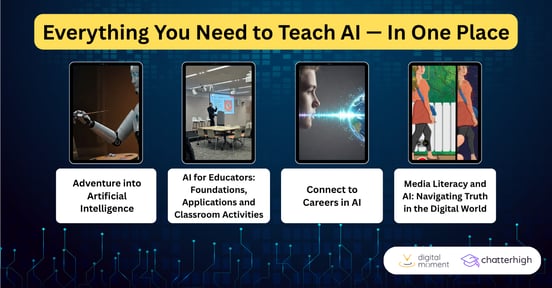
If your students want to build their digital toolkit and equip themselves for careers of the future, they might explore the Digital Citizenship blog, which explores digital literacy, emerging technologies, and the responsible use of technology and AI. Students can also learn more about media literacy, misinformation, digital tactics, social media and more through the Media Literacy and AI: Navigating Truth in the Digital World course, which was created in collaboration with DAIS and Digital Moment.
If you want to go one step further, you and your students could develop your understanding of AI by diving into the Adventure into Artificial Intelligence course from Digital Moment. As a teacher you could explore the AI for Educators: Foundations, Applications and Classroom Activities course, and receive step-by-step lesson plans and slides to use in the classroom.
Reimagine your Route
As individuals, we can each take steps toward reducing our carbon footprint. Greenhouse gases are one of the top concerns in fighting climate change worldwide. The transportation industry accounts for nearly one quarter of all greenhouse gas emissions across the globe, which means reducing fossil fuel consumption is key to climate action.
As an educator, you can explore the ways students travel and how it affects the environment. More importantly, Earth Day is a great way to explore the different ways students can positively contribute today. For example, for students who live close to school, perhaps they might consider walking or biking to school. For students who live farther away, public transportation and carpooling are great ways to take action.
Conclusion
Earth Day celebrates our environment and nature, but it also highlights the importance of climate change initiatives and climate action. Each individual can make a difference, whether switching from a car to a bike or simply using less water. As students discover and explore the climate crisis, it is important to provide them with the knowledge, understanding and resources they need to succeed.
If you want your students to explore how their actions impact the environment, introduce the Ecological Footprint Calculator in your classroom. This five-minute quiz helps students understand how they contribute to the environment and where in their life they can make more sustainable choices.