

by Mary Gannon on 16 Jan, 2026
The world has ushered in a new age of technology, and with it comes immeasurable potential for good or bad. As students navigate innovative new technologies and applications, they will need to do so through the lens of safety, responsibility, and an awareness of AI to understand its transparency and accuracy. Students and educators are spending more and more of their time online, which means understanding digital citizenship and digital literacy are becoming key skills for everyday life.
TL;DR :
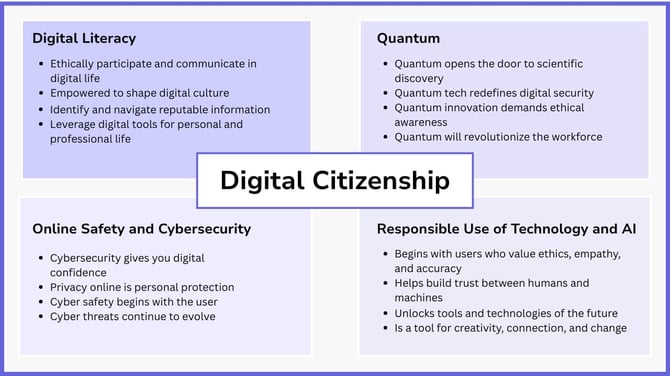
- Digital Literacy is the foundation that helps students establish safe and responsible practices online
- Responsible Use of Technology and AI promotes an ethical understanding of AI technology and its applications
- Online Safety and Cybersecurity are essential building blocks in students digital presence and success online
- Quantum technology is revolutionizing the future from evolving cyber threats to new career opportunities
Digital Literacy
Digital citizenship teaches students how to behave, communicate and make decisions online so they can participate safely and ethically in digital life. It covers online privacy, respectful behaviour, intellectual property and how to spot misinformation. This goes hand-in-hand with digital literacy, which is the ability to use digital technologies, create and interact with content online, conduct accurate and up-to-date research, solve problems, and think critically about the evolving digital landscape.
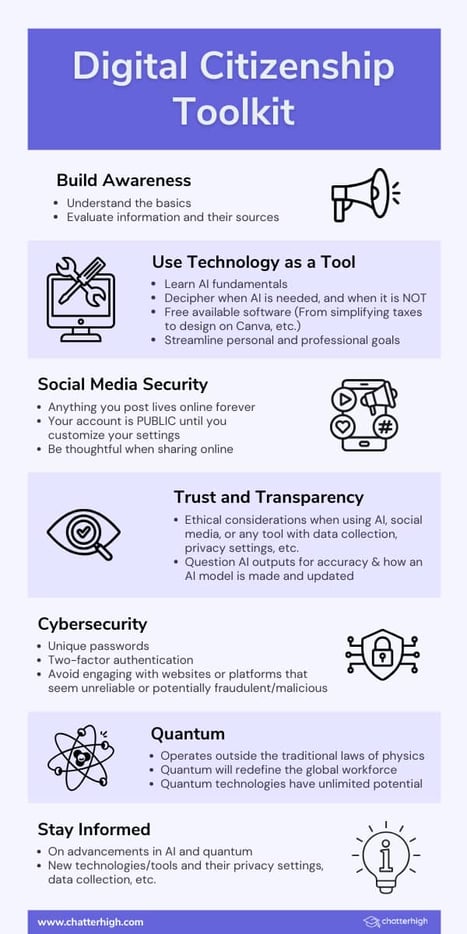 Digital citizenship is the foundation that helps young people establish safe practices online. This could mean interpreting algorithmic feeds and determining what a site or platform is trying to push, resisting manipulative content that is intended to evoke emotion or action, and exercising safe, inclusive and respectful participation in online communities. If you want to further explore how media literacy can help strengthen and protect yourself online, you could explore ChatterHigh’s Media Literacy course from DAIS and Digital Moment, which explores disinformation, deepfakes, and how to build a digital toolkit.
Digital citizenship and digital literacy skills are built in many ways, including exposure to many different sites and platforms. ChatterHigh’s Daily Quiz and Mindful Modules do this by helping students to navigate through reliable resources as they identify relevant and important information. This might mean exploring a postsecondary site, discovering industry or provincial resources, or simply learning how digital literacy will be vital for a successful future in the workforce.
Responsible use of technology and AI
There are many different emerging and evolving technologies, which is why students and teachers alike are responsible for learning and understanding how these technologies are shaping the digital world. Ethics play a large role in the use of online tools, including the creation, integration, and use of artificial intelligence (AI). A responsible online presence might be verifying sources or fact-checking Generative AI, but it also means ensuring AI developers create software with transparency and accountability.
One of the biggest challenges in navigating today’s digital world is AI. AI is built on data and algorithms created by humans, which means AI can make mistakes and show bias. Despite what science fiction may lead you to believe, AI cannot think or feel for itself. Generative AI tools, such as ChatGPT, are not “thinking” of content. These tools use large data sets and algorithms to pull information in a unique way that fits the user's prompt.
As we have seen, ethical AI relies on the proper instruction and use by humans, which means both students and teachers are responsible for not only writing thoughtful and precise prompts, but also verifying sources of information and ensuring that the output or “answers” of an AI model are factually accurate.
Whether it be posting on social media or brainstorming an essay, AI ethics, critical thinking, and digital literacy all help protect students’ privacy and reputation. Framing AI lessons around real harms, biased decisions, or misinformation can help prepare students to use these powerful tools responsibly. If you would like to incorporate the fundamentals of AI, AI ethics, and digital citizenship into your classroom, you can explore ChatterHigh’s Adventure into Artificial Intelligence course developed with Digital Moment. If you want to take AI instruction one step further, ChatterHigh offers AI for Educators: Foundations, Applications and Classroom Activities that will walk you through various AI topics as you learn how to present AI information to students.
As AI is a new and exciting topic, it also ushers in a new wave of jobs and careers never seen before. If your students are passionate about AI and the future it can hold, they may be interested in careers in AI and can explore the Connect to Careers in AI course by Digital Moment.
Online Safety and Cybersecurity
While it is important to be respectful of others online, it is equally important to protect yourself. When interacting with any technology, including AI such as in a chatbot conversation, recommendations on your feed, or voice assistants like Siri or Alexa, students need to be mindful of the personal information they are sharing. It is essential that students understand once something is published or live, it will live online forever.
AI has many different considerations, but it is not only AI that poses a risk. There are many different cyber risks across the digital world, from phishing and malware to data breaches and stolen passwords. This is why understanding cybersecurity is essential for students. Cybersecurity education gives students practical habits and situational awareness so they can avoid common online threats. This means educating on safety practices such as strong passwords, safe Wi-Fi use or two-factor authentication, as well as an awareness of potential dangers including how to spot scams, malware, disinformation and so forth.
Teachers can pair technical protections with tech and security-focused lessons so students understand why protections matter and feel empowered to make safe decisions online. If you want your students to learn about cybersecurity basics, cybersecurity in Canada and even opportunities in the cyber field, you can explore ChatterHigh’s Keep Canada Safe! Discover Careers in Cyber Security by the Communications Security Establishment (CSE).
Quantum
Digital citizenship is not only characterized by staying safe online, alert and up to date with the latest technologies, but also being aware of the rapid growth of technology and what that will bring for the future. Quantum technologies are emerging quickly and will affect many fields, such as cryptography, communications, and computing in many different ways.
You may be wondering how quantum could affect the education industry and teaching day-to-day. At its core, quantum is a different type of science, using qubits rather than the traditional binary code currently enabling digital technologies. In schools, this could look like “quantum-safe” encryption that makes it impossible to breach student and school data, personalized learning for every student enabled by quantum computing, or the revolutionization of STEM to incorporate quantum principles and practices.
Introducing basic quantum literacy, such as what quantum is and how it differs from the traditional laws of physics, can help both students and educators understand future risks and possibilities of Quantum. Practical classroom resources can make quantum concepts accessible and attainable, which is why ChatterHigh and the Quantum Algorithms Institute offer a Quantum in Canada: Careers and Pathways of the Future course.
Conclusion
Digital citizenship, the responsible use of AI, cybersecurity, and even quantum literacy are all essential skills for students and educators in today’s connected world. Together, these areas ensure that students can navigate technology with safety, responsibility, and confidence while preparing for the workforce of tomorrow. By exploring resources like ChatterHigh, students are empowered to make informed choices online and engage in building a safer, smarter digital future.